



Humans and Digitalization: a challenge for transboarder citizenship education
The Centre for Training and Lifelong Learning (K.E.DI.VI.M) of the University of Crete organises course with title : Humans and Digitalization: a challenge for transboarder citizenship education.
Τhe programme will be conducted by Asynchronous Distance Learning.
Application deadline : 20 August 2024.
Start of the Program at 26 of August 2024 (1st week). End at 15 September 2024 (2nd and 3rd weeks)
Applications are closed
Sustainable Development Goals

- 1 Description
-
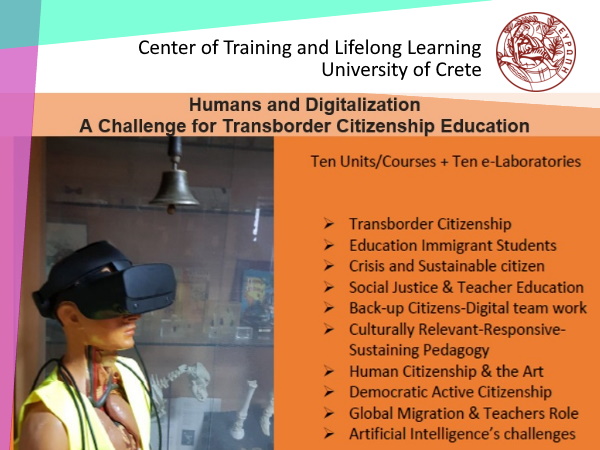
The purpose of the specific training program is to offer the trainees the knowledge so that they can come into contact with the field of Humans and Digitalization: a challenge for transboarder democratic citizenship education in cutting-edge research and theoretical approaches in the context of modern trends and considerations relating to critical digital citizen/citizenship, education for all, extracurricular activities, migrant students and global migration, modern digital skills and basic values and concepts relating to the crisis in education and sustainable development, social justice and teacher education, collaboration skills and backpack citizens, sustaining pedagogy, the role of the Art, as well as the e-citizen and the challenge of Artificial Intelligence. The aim of the program is for the trainees to acquire the necessary knowledge, techniques and skills and problematic that will be applauded, which concern the above mentioned area, that is Humans and Digitalization: a challenge for transboarder citizenship education in the 21st century.
Program Objective
The Program Objective is to offer to the trainers knowledge, attitudes, skills that have to do with the proposed area of the Program, that is Humans and Digitalization: a challenge for transboarder citizenship education in the framework of modern trends and issues that are discussed the field. The knowledge, the theories and researches that also combined with the digital citizen of the 21st century will be analyzed in the texts and the accompanied e-laboratories of the program.
Educational goals of the program
Cognitive Skills
The cognitive skills of the program are related to the ability to compile, organize and analyse theoretical and research approaches through comparisons, predictions and observations in the filed of Humans and Digitalization area as well as the challenges for transboarder citizenship education today, education for all, sustainable development and pedagogy, social justice, collaboration skills, the role of the art the extracurricular activities, migration issues and digital challenges like AI challenges.
Psychomotor skills
The psychomotor skills of the program have to do with the ability to use stimuli that develop into a motor activity, to take initiative, to prioritize mains concepts and problematic concerning the humans of modern era, the challenges of digitalization area (example the role of AI etc), as well as
the citizenship education in the 21st century via ‘e-citizen’ concept and related values, like social justice, collaboration and opportunities/challenges in teacher education.Behaviours/attitudes
The program will offer to the participants ways to behave and acquire attitudes related to main theme of the program and develop their ability to use and acquire cognitive and psychomotor skills in different situations that have to do with the citizen, the citizenship education, the digital era and the existing challenges in formal and non-formal types of citizenship education, extracurriculum challenges, the use of art, attitudes towards migration issues, digitality and teachers education.
Who it is aimed at
Students and Higher Education Degree holders, Teachers of any level, Educators, Sociologists, Master degree and PhD (holders or candidates), participants of any kind of field who are interested for the topic.
Participation fees
380 € (must be paid before the starting of the Program).
- 2 Content
-
Teaching Module Duration of teaching modules (hours) 1. Humans and Digitalization: A challenge for transboarder citizenship education and society: 4,5 hours 2. Educating A World on the Move: Education for All (Migrant) Students 4,5 hours 3. Crisis in Education and the digital citizen and Sustainable development: 4,5 hours 4. Social Justice Education and Socially Just Teacher Education 4,5 hours 5. Digital market- unemployment- backpack citizens-team work and digital collaboration skills 4,5 hours 6. Culturally Relevant-Responsive-Sustaining Pedagogy: Challenges and Opportunities 4,5 hours 7. Digital Human Citizenship Skills, the role of the Art 4,5 hours 8. Fostering Democratic Active Citizenship in and through K-12 Education and Teacher Education: Community Service and Extracurricular Activities 4,5 hours 9. Reimagining Teacher Education for Immigrant Students in the Context of Global Migration: Teacher Education and the Role of Teacher Educators 4,5 hours 10 E-citizen in the 21st century: Articfical Intellingence’s challenges 4,5 hours TOTAL HOURS 45 - 3 Scientific Coordinator
-
Pella Calogiannakis
Dr. Pella Calogiannakis is Professor of Comparative Education at the Pedagogical Department of Teacher Education at University of Crete, Greece. She studied at Sorbonne, Paris-V, Rene Descartes in Paris, France (D.E.A & PhD). Her research interests are related with Comparative Education and Political Socialization, especially on ‘human-citizen and world crisis, having experience in research and coordination of European programs on vulnerable people, on Teachers Training and Re-training in the area of critical pedagogy and socialization.
She is also a DVP of Zhengzhou University, P.R., in China. She is the author of ten books and editor (or co-editor) of 12 handbooks; she has published about 90 articles different languages (greek, english, french, chinese, japanese, africans, turkish, arab and russian languages) and over 2000 citations in google scholar. She has participated in many international congresses on Comparative Education and Citizenship Education in Greece & Europe, United States, Asia and Africa. She has lectured at the University of at North-West University’s Potchefstroom in South Africa and in Saint John’s University in New York. She is the Coordinator in Crete for the European Program on the ‘Integration of Roma children in schools’ and Director of the post-graduate Program of the University of Crete-School of Education, on “Sciences of Education, Critical Pedagogy and Teachers Education”. - 4 Trainers
-
Scientific Cordinator
Professor
Department of Teacher Education at University of Crete, Greece
Academic Cordinator
Associate Professor
TED University in Türkiye
Participation fee
380 €
Teaching Hours
45
Start Date
26/08/2024
Duration
3 weeks
ECTS
1,8
Scientific Coordinator
Academic Coordinator
Sibel Akin Sabuncu TED University in Türkiye
Applications are closed
Information & Registration
kedivim@uoc.gr