
MOOC
- Details
MOOC
The "Applications in the Python Programming Language" program at the University of Crete's KEDIVIM is a comprehensive annual learning path that starts from zero and progresses to the development of modern applications. Participants learn the basic concepts of Python step by step (arithmetic operations, strings, lists, control structures, functions, dictionaries, sets, files, modules) and move on to more advanced topics such as object-oriented programming, exception handling, data analysis and visualization with numpy, pandas, and matplotlib, geospatial data and maps, as well as statistical processing of real datasets.
The program further focuses on the practical aspects and applications of programming: creating interactive web applications with Streamlit, developing graphical user interface (GUI) applications, introduction to databases with SQLite, image processing and motion detection with OpenCV, creation and scanning of QR codes, basic encryption techniques, task automation (email sender, translator, WhatsApp application), and even simple examples of drone programming. The program combines video lectures, material files, exercise series, and Python Challenges so that each trainee can gradually build their skills and reach the point where they can design and implement complete, functional applications for work, study, or everyday life.
Projects 2024-2025
https://www.youtube.com/playlist?list=PLnTTgHKAu8E9n3K76YPlM73JTasPAyVLL
Projects 2023-2024
https://www.youtube.com/playlist?list=PLnTTgHKAu8E_WqIpXRrdXB7ZPC6HWLRrT
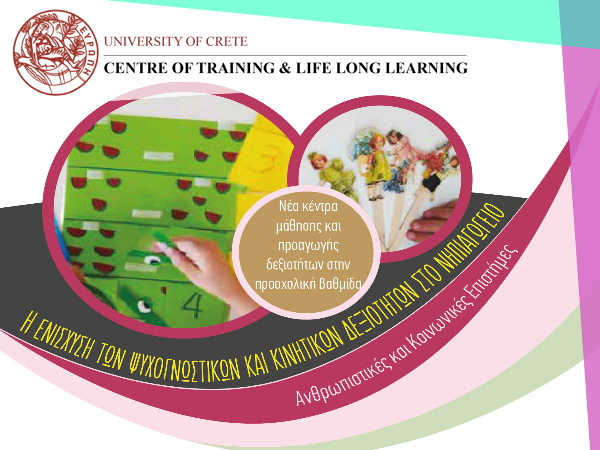
Strengthening psycho-cognitive and motor skills in preschool age
Fine motor skills are crucial for the holistic development of preschool children. By improving the small muscle movements of their hands and fingers, children acquire basic skills such as writing, dressing, and using tools. In addition, motor skills are directly linked to their cognitive and linguistic development and are essential prerequisites for success in the educational process and in their social life. Fine motor skills are related to a number of important (executive) functions that enable us to plan, organize, initiate, and complete tasks. Furthermore, it appears that learning processes in which the body is actively involved have a significant impact on early language development and are considered superior to learning processes that do not involve the child's body. Consequently, preschool children need daily practice with developmentally appropriate fine motor activities so that they can successfully approach their later school literacy, build their self-esteem, their autonomy, and, most importantly, the skills they will need later in life.
This book combines theoretical analysis and practical activities, offering valuable suggestions for parents and teachers who want to strengthen the fine motor skills of their children and/or their students. With rich material based on research and experience, it sparks important pedagogical considerations in the direction of strengthening children's fine motor skills, which in turn serve as a fundamental foundation for the development of their autonomy (cognitive, emotional, motor), enabling them to explore the world around them with confidence and creativity.
The cultivation of fine motor skills in preschool age
"Human-centered Artificial Intelligence in Education: Transforming the way we learn and teach."
- Seminar Implementation Methodology
The seminar will be implemented exclusively using the Massive Open Online Course (MOOC) method, providing maximum flexibility in terms of location, time, and pace for participants.
In the EDIVEA [EDIVEA.NET] learning environment, you will have the opportunity to:
a. Interact with the educational material, which has been designed based on the principles and methodology of MOOC.
b. Experience collaborative distance learning by utilizing the Learning Social Network (LSN), with the ultimate goal of creating a learning community of education consultants.
c. Complete the assessment (test) for each teaching module.
- Requirements for Successful Completion – Training Certification
In order to successfully complete the training program, trainees must achieve a score of at least 80% on the Teaching Module Tests (one for each Teaching Module).
Successful completion of the training program leads to the award of a Training Certificate from KEDIVIM of the University of Crete. The training certificate is awarded in electronic form.
- Contact
For any questions, please contact the EDIVEA secretariat at: This email address is being protected from spambots. You need JavaScript enabled to view it.
KEDIVIM
Centre of Training and Lifelong Learning
University of Crete
Submit a complaint / objection
Follow us
Contact
email: kedivim AT uoc.gr
Aikaterini Tsalimi
Head of KEDIVIM
tel: 2810 393660
email: katerina.tsalimi AT uoc.gr
Maria Partali
Secretariat
tel: 2810 393661
email: partalim AT uoc.gr
Konstantina Pyrgiotaki
Secretariat
tel: 2810 393662
email: kpirgiotaki AT uoc.gr
Location
University of Crete
Voutes Campus
Postal Code: 70013
Vasilika Vouton, Heraklion
Administration Building ΙΙ
Office 207
Access instructions